Martyr · 1 min summary
St. Pancras of Rome
Pancras is venerated as a Roman martyr. His traditional age of fourteen and the detailed account of his death come from later sources.
Listen to this story with read-aloud →
Feast date: May 12
A life in brief
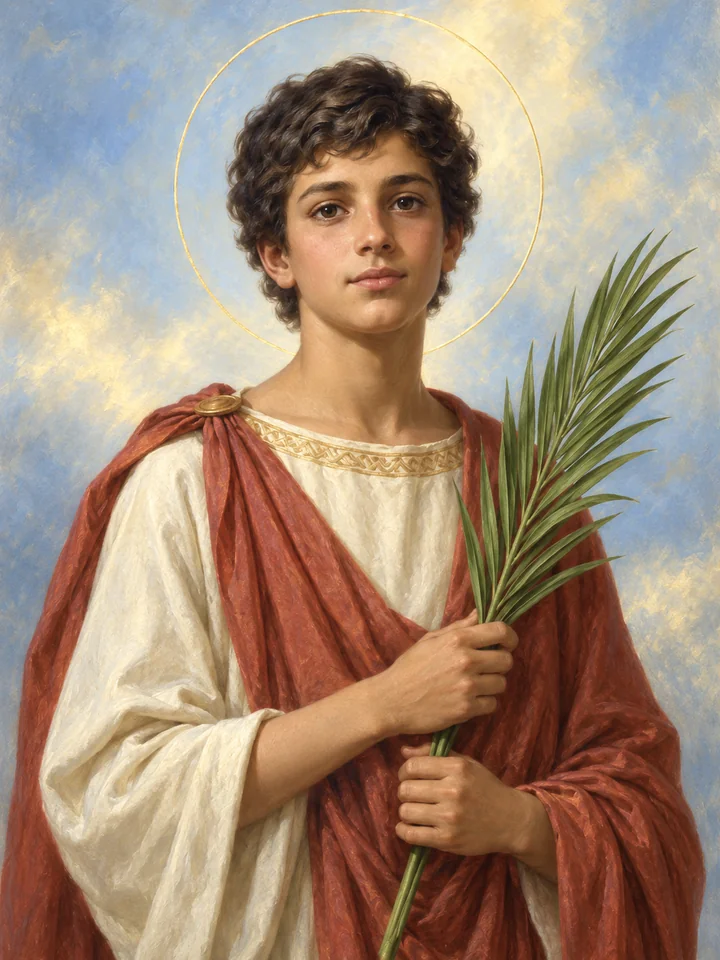
Pancras is venerated as a Roman martyr. The later account describes him as a convert executed at fourteen, traditionally around 304; these details and the date are uncertain. His name is Greek, meaning 'all-powerful'.
From an early period, Pancras was venerated together with Nereus and Achilleus in a shared feast day and Mass formula on 12 May. In 1595, 25 years after Pope Pius V promulgated the Tridentine Missal, Domitilla was also added.
Since 1969, Pancras has been venerated separately, still on 12 May. He is traditionally the second of the Ice Saints. In the Syriac traditions he is known as Mor Izozoel (Mar Azazael), remembered on 12 May and 12 August. He is the patron saint of children.
The London district of St Pancras, and by extension St Pancras railway station, is named after St Pancras Old Church and St Pancras New Church.
View full biography
In this story
Pancras (Latin: Sanctus Pancratius) is venerated as a Roman martyr. The later account describes him as a convert executed at fourteen, traditionally around 304; these details and the date are uncertain. His name is Greek (Πανκράτιος Pankrátios), meaning 'all-powerful'.
From an early period, Pancras was venerated together with Nereus and Achilleus in a shared feast day and Mass formula on 12 May. In 1595, 25 years after Pope Pius V promulgated the Tridentine Missal, Domitilla was also added.
Since 1969, Pancras has been venerated separately, still on 12 May. He is traditionally the second of the Ice Saints. In the Syriac traditions he is known as Mor Izozoel (Mar Azazael), remembered on 12 May and 12 August. He is the patron saint of children.
The London district of St Pancras, and by extension St Pancras railway station, is named after St Pancras Old Church and St Pancras New Church.
Legend
Because he was said to have been martyred at the age of fourteen during the persecution under Diocletian, Pancras would have been born around 289, at a place designated as near Synnada, a city of Phrygia Salutaris, to parents of Roman citizenship. When Pancras was nine years old, his mother Cyriada died during childbirth; his father died of grief not long after. Pancras was entrusted to his uncle Dionysius' care. They both moved to Rome to live in a villa on the Caelian Hill. They were converted to Christianity by one Marcellinus, and Pancras became a zealous adherent of the religion. Dionysius subsequently died, leaving Pancras on his own.
During the persecution of Christians by Emperor Diocletian, around 303 AD, he was brought before the authorities and asked to perform a sacrifice to the Roman gods. Diocletian, impressed with the boy's determination to resist, promised him wealth and power, but Pancras refused, and finally the emperor ordered him to be beheaded on the Via Aurelia, on 12 May 303 AD. The account has chronological problems, including its association of the persecution under Diocletian with Pope Cornelius, whose pontificate was in 251–253. Diocletian did visit Rome in 303 for his imperial anniversary; his movements do not support the claim that he had been absent since 286.
A Roman matron named Octavilla recovered Pancras' body, covered it with balsam, wrapped it in precious linens, and buried it in a newly built sepulchre dug in the Catacombs of Rome. Pancras' head was placed in the reliquary that still exists today in the Basilica of Saint Pancras.
Veneration
Devotion to Pancras existed from the fifth century onwards, for the basilica of Saint Pancras was built by Pope Symmachus (498–514), on the place where the body of the young martyr had been buried; his earliest passio seems to have been written during this time. Gregory of Tours discussed Pancras’s tomb and devotion to him in Liber in gloria martyrum (Glory of the Martyrs). He should not be confused with Pope Gregory the Great. Devotion to Pancras also became established in England, where a number of churches bear his name, including St Pancras Old Church in London.
In medieval iconography, Pancras was depicted as a young soldier, due to his association with the paired soldier saints Nereus and Achilleus.
Pancras is popularly venerated as the patron saint of children, jobs and health. His name is also invoked against cramps, false witnesses, headaches and perjury. His image in statue form can be found in many bars, restaurants and other businesses. He is also the patron saint of the Italian city San Pancrazio Salentino.
The Tridentine calendar had on 12 May a joint feast (semidouble rank) of Nereus, Achilleus and Pancras. The name of Domitilla was added in 1595. The joint celebration of Nereus, Achilleus, Domitilla and Pancras continued with that ranking (see General Roman Calendar of 1954) until the revision of 1960, when it was reclassified as a third-class feast (see General Roman Calendar of 1960).
In the present General Roman Calendar, revised in 1969, Saints Nereus and Achilleus (together) and Saint Pancras have distinct celebrations (optional memorials) on 12 May. Saint Domitilla is not included in the revised calendar, because the liturgical honours once paid to her "have no basis in tradition".
Biography adapted from Wikipedia contributors under CC BY-SA 4.0. Read attribution and adaptation details.
Sources and editorial notes
Historical biography adapted from “Pancras of Rome” by Wikipedia contributors, under CC BY-SA 4.0.
Source reference: https://en.wikipedia.org/wiki/Pancras_of_Rome
Source revision: 1373007322.
The feast date, when listed, comes from the biography’s source metadata. Customs and local calendars may differ.
Focused editorial review, 2026-09-24: early shrine evidence and limits of the later martyrdom account. This review covers the identified points, not independent verification of every statement.
Corrections in this edition: Distinguish early veneration from the later account of his age and execution. Correct the attribution of Glory of the Martyrs to Gregory of Tours, rather than Gregory the Great. Correct the erroneous statement about Diocletian’s absence from Rome while retaining the narrative’s chronological uncertainty.
Historical references
J. P. Kirsch, Catholic Encyclopedia (1911), Sts. Nereus and Achilleus, Domitilla and Pancratius
Checked points: Distinguish early veneration from the later account of his age and execution.
University of Oxford, Cult of Saints in Late Antiquity, evidence E00538 (listed under S00060)
Checked points: Correct the attribution of Glory of the Martyrs to Gregory of Tours, rather than Gregory the Great.
Mark Humphries, Emperors, Usurpers, and the City of Rome, Oxford University Press (2015)
Checked points: Correct the erroneous statement about Diocletian’s absence from Rome while retaining the narrative’s chronological uncertainty. Diocletian visited Rome in 303 for the vicennalia; that fact does not independently establish Pancras’s trial narrative.
Traditional accounts and later legends should be read with the qualifications in the biography. An attribution or date check is not a claim of independent review of the entire life.