Missionary · 2 min read
St. Nino
Nino was a woman who preached Christianity in the territory of the Kingdom of Iberia in what is now Georgia.
Listen to this story with read-aloud →
Devotional associations: Georgia
Feast date: January 14; December 15January 14 is recorded in the Roman Martyrology and Eastern calendars; December 15 is a Western local commemoration.
In this story
Saint Nino (sometimes St. Nune, St. Nina or St. Ninny; Georgian: წმინდა ნინო, romanized: ts'minda nino; Armenian: Սուրբ Նունե, romanized: Surb Nune; Greek: Ἁγία Νίνα, romanized: Hagía Nína) was a woman who preached Christianity in the territory of the Kingdom of Iberia in what is now Georgia. Her preaching led to the Christianization of Iberia.
According to most traditional accounts, she belonged to a Greek -speaking Roman family from Kolastra, Cappadocia, was a relative of Saint George, and came to Iberia from Armenia.
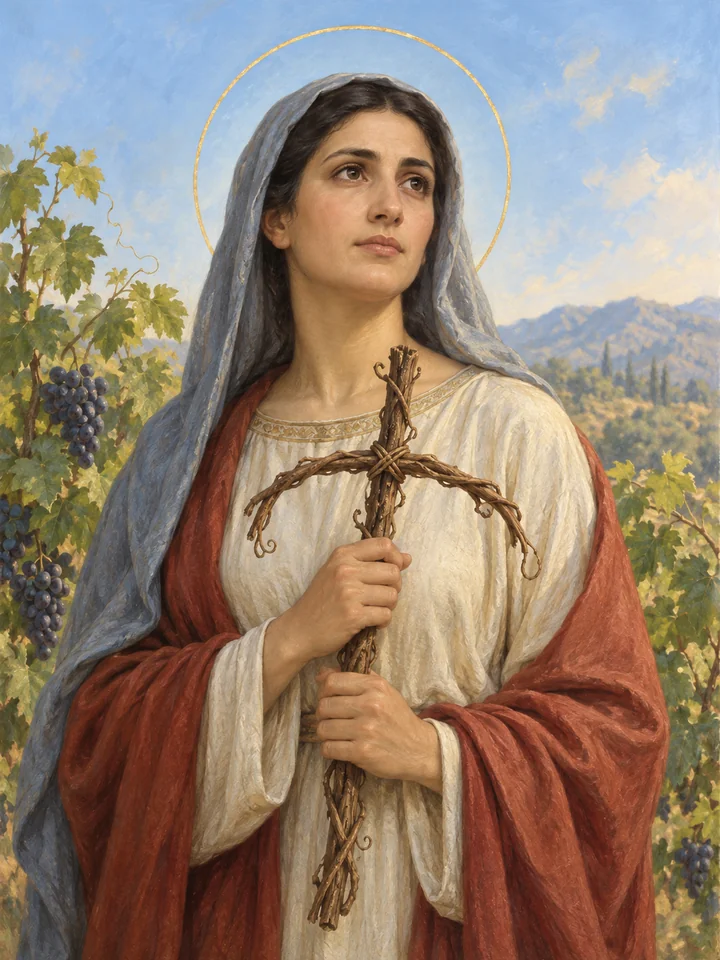
At the age of 14, Nino served as a lady-in-waiting to a Christian noblewoman whom Diocletian wished to marry. The woman refused, and Nino, together with her mistress and other attendants, fled to avoid persecution. All were killed except Nino, who survived by hiding. According to tradition, she then received a vision of the Virgin Mary, who gave her a grapevine cross and instructed her to travel to Iberia (modern-day Georgia) to spread the Christian faith. Nino traveled to Iberia, preached Christianity, and converted the entire country.
According to tradition, she performed miraculous healings and converted the Georgian queen, Nana, and eventually the pagan king Mirian III of Iberia, who, lost in darkness and blinded on a hunting trip, found his way only after praying to "Nino's God". Mirian declared Christianity the official religion of his kingdom (c. 326), and Nino continued her missionary activities among Georgians until her death.
Her tomb is still venerated at the Bodbe Monastery in Kakheti, eastern Georgia. She has become one of the most venerated saints of the Georgian Orthodox Church, and her attribute, the grapevine cross, is a symbol of Georgian Christianity.
She was named Christiana by Rufinus and Theognosta by the Byzantines.
Biography adapted from Wikipedia contributors under CC BY-SA 4.0. Read attribution and adaptation details.
Sources and editorial notes
Historical biography adapted from “Saint Nino” by Wikipedia contributors, under CC BY-SA 4.0.
Source reference: https://en.wikipedia.org/wiki/Saint_Nino
Source revision: 1371787677.
Feast-date reference: Nominis, Catholic Church in France — Sainte Nino. Date reference checked 2026-09-24.
Additional calendar context: St. Nino — biography and calendar notes (Wikipedia contributors)
Traditional accounts and later legends should be read with the qualifications in the biography. An attribution or date check is not a claim of independent review of the entire life.