Priest or Deacon · 1 min summary
St. Jose Gabriel del Rosario Brochero
José Gabriel del Rosario Brochero was an Argentine Catholic priest remembered for his pastoral service in rural Córdoba.
Listen to this story with read-aloud →
Devotional associations: Córdoba Clergy Major Seminary of Córdoba Diocese of Cruz del Eje
Feast date: March 16Commemorations can vary by local and liturgical calendar; the biography records the traditions associated with this saint.
A life in brief
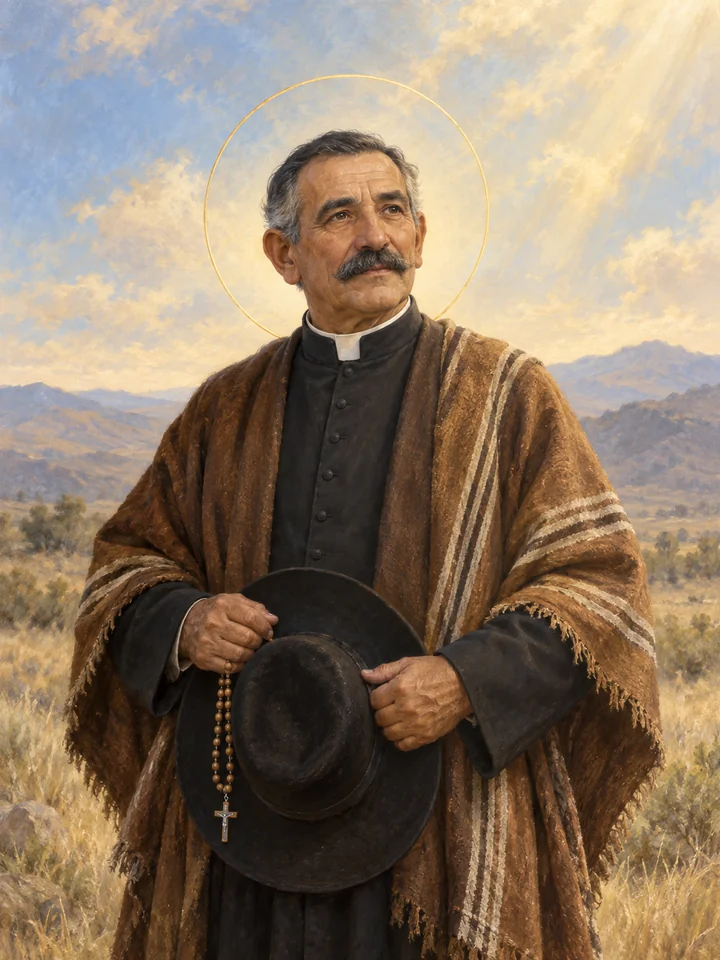
Joseph Gabriel of the Rosary (sometimes José Gabriel del Rosario Brochero; 16 March 1840 – 26 January 1914), also referred to as Priest Brochero, was an Argentine Catholic priest who developed leprosy later in life. He is known for his extensive work with the poor and the sick. He became affectionately known as "the Gaucho priest" and the "cowboy priest".
He was beatified on 14 September 2013 after a healing was recognized as a miracle attributed to him. Cardinal Angelo Amato – on the behalf of Pope Francis – presided over the beatification. Another miracle under investigation was approved in 2016 and a date for canonization was approved in a gathering of cardinals on 15 March 2016; Brochero was canonized on 16 October 2016.
Brochero was born on 16 March 1840 in Argentina as the fourth of ten children to Ignacio Brochero and Petrona Davila; he had two sisters and the others were brothers. Two sisters became nuns. He was baptized on 17 March along with the registration of his birth.
View full biography
Joseph Gabriel of the Rosary (sometimes José Gabriel del Rosario Brochero; 16 March 1840 – 26 January 1914), also referred to as Priest Brochero (in Spanish: Cura Brochero), was an Argentine Catholic priest who developed leprosy later in life. He is known for his extensive work with the poor and the sick. He became affectionately known as "the Gaucho priest" and the "cowboy priest".
He was beatified on 14 September 2013 after a healing was recognized as a miracle attributed to him. Cardinal Angelo Amato – on the behalf of Pope Francis – presided over the beatification. Another miracle under investigation was approved in 2016 and a date for canonization was approved in a gathering of cardinals on 15 March 2016; Brochero was canonized on 16 October 2016.
Life
Brochero was born on 16 March 1840 in Argentina as the fourth of ten children to Ignacio Brochero and Petrona Davila; he had two sisters and the others were brothers. Two sisters became nuns. He was baptized on 17 March along with the registration of his birth.
He commenced his studies to become a priest at the College Seminary of Our Lady of Loreto on 5 March 1856, shortly before his sixteenth birthday and during his studies he met the future president Miguel Ángel Juárez Celman. Brochero received the tonsure on 16 July 1862; he was received into the subdiaconate on 26 May 1866 and then into the diaconate on 21 September 1866. He had joined the Third Order of Saint Dominic on 26 August 1866. He was ordained to the priesthood in the diocese of Córdoba on 4 November 1866 at the age of 26 under Bishop José Vicente Ramírez de Arellano and celebrated his first Mass the following 10 December. Brochero was later appointed as a prefect of studies of the seminary and was awarded the title of Master of Philosophy on 12 November 1869.
Brochero founded a home in 1875 for people known as the Houses of Exercises (inaugurated in 1877) and later established a school for girls in 1880. He requested and obtained from the authorities courier posts, post offices and telegraphic posts and also planned the rail network that would go through the Valley of Traslasierra joining Villa Dolores and Soto. He devoted all of his energy to those who required his help and no sick person was left devoid of the sacraments, as there was no force that could stop him helping them, and he had even said "woe if the devil is going to rob a soul from me".
Brochero was known to travel long distances in Argentina on the back of a mule dressed in a sombrero and a poncho to serve the needs of the Christian faith throughout his huge parish. He cared for the sick during the cholera epidemic of 1867 and contracted leprosy during his travels; it was believed that it came from drinking yerba mate with some of the patients with the affliction. He became well known to his parishioners and made efforts to improve all aspects of their involvement in church life. He became blind and deaf towards the end of his life. Throughout his travels to meet parishioners he would bring with him the image of the Blessed Virgin Mary, his Mass kit and a prayer book.
He was appointed to successive positions such as Canon of the Cathedral of Córdoba on 24 April 1898. He left for that post on 30 May but was later appointed as a pastor in Villa del Transito on 25 August 1902, arriving there on the following 3 October. He resigned from his position as pastor on 5 February 1908 and returned the following 30 March back home to live with his sisters.
Brochero died on 26 January 1914, his last words being: "Now I have everything ready for the journey". A Catholic newspaper later wrote of him: "It is known that Father Brochero contracted the sickness that took him to his tomb, because he visited at length and embraced an abandoned leper of the area".
Legacy
In Port-au-Prince in Haiti a rehabilitation clinic for the handicapped was opened in honor of Brochero, dubbed Kay Gabriel ("Gabriel's house").
Veneration
Diocesan process and beatification
The cause of beatification commenced on 17 March 1967 under Pope Paul VI in Argentina which gave him the title Servant of God; the actual process started in 1968 which saw the gathering of both documents and witness testimonies that pertained to his life and virtues. The positio was submitted to Rome in 1997 in order for the Congregation for the Causes of Saints for further evaluation.
Pope John Paul II recognized that Brochero lived a life of heroic virtue and named him to be venerable on 19 April 2004. Pope Benedict XVI approved a miracle attributed to Brochero's intercession on 20 December 2012 which would allow for his beatification to take place. The miracle involved Nicolas Flores who was in a vegetative state after a severe car crash when he was eleven months old and was cured through the intercession of Brochero.
Cardinal Angelo Amato presided over the beatification in Argentina on 14 September 2013 and announced Brochero's feast would be celebrated on 16 March.
Pope Francis – in his Angelus address on 15 September to mark the occasion – praised Brochero for his open heart to all and stated that "he knew the love of Jesus. He let his heart be touched by the mercy of God" which he extended to all people. The pope also said that Brochero was a man who "dedicated himself entirely to his flock" in order to evangelize to them and that the needs of the people came first as his sole focus.
Second miracle
Pope Francis canonized Brochero in Saint Peter’s Square on 16 October 2016.
The diocesan process for the second miracle – the healing of a girl – commenced on 16 July 2014 and concluded its business on 25 March 2015; the process received the formal decree of ratification on 28 March 2015. The miracle proceeded to the Medical Board in Rome on 10 September 2015 and was approved and theologians also approved the miracle on 3 November 2015. The congregation met to discuss the cause on 12 January 2016 and received its full approval.
Pope Francis approved the second miracle attributed to Brochero on 21 January 2016 and confirmed the date of the late priest's canonization at a gathering of cardinals to be held on 15 March 2016; Brochero was canonized as a saint of the Roman Catholic Church on 16 October 2016 in Saint Peter's Square. The postulator at the time of the canonization was Silvia Mónica Correale.
Biography adapted from Wikipedia contributors under CC BY-SA 4.0. Read attribution and adaptation details.
Sources and editorial notes
Historical biography adapted from “Jose Gabriel del Rosario Brochero” by Wikipedia contributors, under CC BY-SA 4.0.
Source reference: https://en.wikipedia.org/wiki/Jose_Gabriel_del_Rosario_Brochero
Source revision: 1364133104.
The feast date, when listed, comes from the biography’s source metadata. Customs and local calendars may differ.
Focused editorial review, 2026-09-24: birth, ordination, pastoral work, later illness, death and canonization date. This review covers the identified points, not independent verification of every statement.
Corrections in this edition: Correct the unsupported claim that he had leprosy throughout his life. Reconcile his seminary-entry age with the documented birth and entry dates. Replace obsolete speculation about the place and date of canonization with the completed event. Correct Nicolás Flores’s age at the accident; thirteen years was the interval before beatification.
Historical references
Dicastery for the Causes of Saints, José Gabriel del Rosario Brochero
Checked points: Correct the unsupported claim that he had leprosy throughout his life. Reconcile his seminary-entry age with the documented birth and entry dates. Born 16 March 1840; ordained 4 November 1866; died 26 January 1914.
Holy See Press Office, canonizations of 16 October 2016
Checked points: Replace obsolete speculation about the place and date of canonization with the completed event. Canonized by Pope Francis on 16 October 2016.
AICA, interview with the family of Nicolás Flores, September 2013
Checked points: Correct Nicolás Flores’s age at the accident; thirteen years was the interval before beatification.
Traditional accounts and later legends should be read with the qualifications in the biography. An attribution or date check is not a claim of independent review of the entire life.