Martyr · 1 min summary
St. Balbina of Rome
Balbina is venerated as an early Christian martyr in Rome; the surviving accounts of her life are largely legendary.
Listen to this story with read-aloud →
Devotional associations: Struma, Scrofulous Diseases, Goiter, Throat Diseases
Feast date: March 31
A life in brief
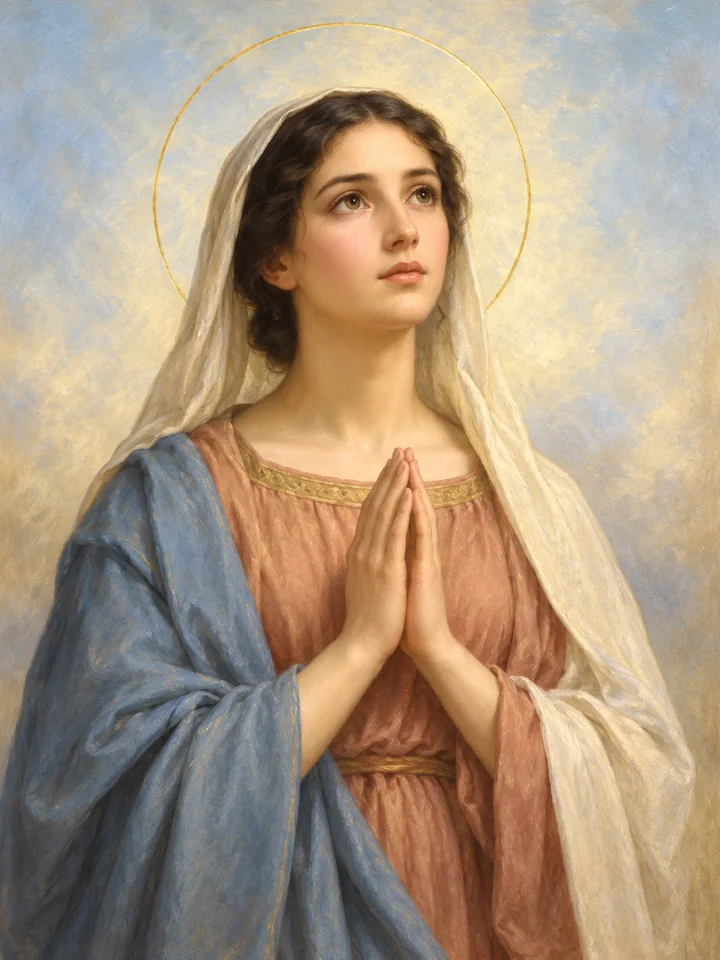
Balbina of Rome is venerated as a Christian saint. The detailed story connecting her with Quirinus and Pope Alexander comes from legendary acts; it should be distinguished from the Roman churches, cemetery traditions and other evidence of her veneration.
Most stories agree that in 130 Balbina was found guilty of being a Christian and sentenced by Emperor Hadrian to death, whether drowned or buried alive varies.
According to the burial tradition, after Balbina’s death, she was apparently to be buried next to her father in the catacomb of Praetextatus on the Via Appia. At a later date, the stories go, the bones and relics of Quirinus and Balbina would have been brought to the church built in her honour in the 4th century.
View full biography
In this story
Balbina of Rome is venerated as a Christian saint. The detailed story connecting her with Quirinus and Pope Alexander comes from legendary acts; it should be distinguished from the Roman churches, cemetery traditions and other evidence of her veneration.
Legend
The story of Balbina is introduced in the legendary Acts of Sts. Alexander and Balbina, where it is said that she was the daughter of Quirinus, a Tribune in the Roman Army.
Reference to this myth is also to be found in Usuardis' martyrology; his account of Balbina is entangled with the supposed martyrdom of Pope Alexander I. In fact, there is nothing to suggest this early pope was martyred. There was indeed a martyr of the same name, about whom nothing has survived to the present day, but the 1570 Tridentine calendar does not suggest he had been a pope.
Legend has it that Quirinus was ordered to hold Pope Alexander and a man named Hermes in prison because of their Christian faith. They were in separate prisons a fair way apart, and both were shackled and well-guarded. Quirinus had been trying to turn Hermes back to the old gods, but had promised to become a Christian if Hermes could prove that there was an afterlife. Hermes is then said to have explained that Pope Alexander could make a better argument than he. He asked repeatedly to visit his prison. At first, Quirinus agreed to this, but after a while he became angry, convinced that these visits were frivolous excursions. He tightened the guard at both places, so that the two would not be able to communicate. That night Hermes prayed, and an angel is said to have appeared to Pope Alexander, releasing his chains and transporting him to Hermes' prison cell.
The next morning Quirinus came to Hermes' cell as usual, and he was shocked to find both men inside. His heart now open to what the two Christians had to say, he stayed and talked with the men for a while. Hermes is now said to have shared his own story: how his own son had been restored to life by the pope, with God's help. Hearing this, Quirinus said that his daughter Balbina had a large goitre; if the pope could heal her, he would believe and become a Christian. The pope asked him to bring her to his own prison cell. "How can she find you there, when you're here with Hermes?" Quirinus is said to have asked. "He who brought me here, will also bring me back", the pope is said to have replied.
The story continues that Quirinus quickly returned home and brought his daughter to the prison where he had originally locked up Pope Alexander. There, they found Alexander patiently waiting for them, tightly shackled as before. Seeing this, they knelt before him in reverence.
Full of devotion, Balbina started to kiss the links of the pope's chains. But he said to her: "You shall not kiss these chains, but go out and find St. Peter's chains. Once you've found them, kiss them with devotion and you will soon be well."
Knowing where Peter had been held before his martyrdom, Quirinus jumped up immediately and took Balbina with him, where he found the chains. Balbina kissed them and was soon well. Quirinus immediately had Pope Alexander and Hermes pardoned and released. Along with his wife and daughter, he was baptised by the pope.
The legend continues that Pope Alexander stipulated that the miracle of the chains should be celebrated from that day forward, and that he built the church of the Apostle Peter, where the chains have been held ever since. In fact Pope Alexander had died in 115. Today's church of St. Peter in Chains was not consecrated until more than three centuries later, by Pope Sixtus III.
Another fabled account has Quirinus placed as the one ordered to execute Alexander and two others, Eventius and Theodolus, who had been arrested by order of Trajan. However, Quirinus had converted to Christianity after witnessing miracles performed by these three saints, then to be baptised along with his wife, and daughter Balbina.
In both of these fanciful stories, Quirinus was then arrested as a Christian, and martyred through decapitation on 30 March 116. He was buried in the catacomb of Prætextatus on the Via Appia. His grave was later regarded with great veneration and is referred to in the old itineraries (guides for pilgrims) of the Roman catacombs.
The story of Balbina does not elaborate on what happened to her after the death of her father. Some versions have her living as a virgin recluse nun until her death, supposedly in 130.
Death
Most stories agree that in 130 Balbina was found guilty of being a Christian and sentenced by Emperor Hadrian to death, whether drowned or buried alive varies.
In an alternative version, it was in 166 that Balbina was arrested along with her father, and beheaded.
According to the burial tradition, after Balbina’s death, she was apparently to be buried next to her father in the catacomb of Praetextatus on the Via Appia. At a later date, the stories go, the bones and relics of Quirinus and Balbina would have been brought to the church built in her honour in the 4th century.
Veneration
A statue of St. Balbina is among the 140 on the colonnade of St. Peter's Square.
Some of her supposed relics were brought to Cologne Cathedral during the Middle Ages, most likely around 1050 when relics attributed to Quirinus would have found their way to Pope Leo IX. He passed them on to an abbess of Neuss named Gepa (who is called a sister of the pope).
The majority of the supposed relics are said to still be in the altar of Santa Balbina.
At some point in the late 15th or early 16th century, a skull attributed to Balbina was removed from her body and placed inside an ornate reliquary. This reliquary now resides in the Metropolitan Museum of Art in New York City.
Basilica of Santa Balbina
Santa Balbina is a basilica church in Rome, devoted to St. Balbina. It was built in the 4th century over the house of consul Lucius Fabius Cilo on the Aventine Hill, behind the Baths of Caracalla.
The site should not be confused with a catacomb named after Balbina (coem. Balbinae) which lay between the Via Appia and the Via Ardeatina not far from the little church called Domine quo vadis. Over this cemetery, another, now lost basilica was erected in the fourth century by Pope Mark. Tradition has it that it was at this church that the Emperor Constantine bade farewell to the pope on his departure to found the city that became Constantinople.
Biography adapted from Wikipedia contributors under CC BY-SA 4.0. Read attribution and adaptation details.
Sources and editorial notes
Historical biography adapted from “Balbina of Rome” by Wikipedia contributors, under CC BY-SA 4.0.
Source reference: https://en.wikipedia.org/wiki/Balbina_of_Rome
Source revision: 1369241675.
The feast date, when listed, comes from the biography’s source metadata. Customs and local calendars may differ.
Focused editorial review, 2026-09-24: legendary family narrative, evidence of veneration and distinction from the attested martyr Quirinus. This review covers the identified points, not independent verification of every statement.
Corrections in this edition: Distinguish a legendary narrative from a categorical claim that the person and all evidence of veneration are fictitious. Use precise attribution instead of treating uncertain biography as proof of nonexistence. Do not dismiss the attested Roman martyr Quirinus because the later story of his family is legendary.
Historical references
J. P. Kirsch, Catholic Encyclopedia (1907), St. Balbina
Checked points: Distinguish a legendary narrative from a categorical claim that the person and all evidence of veneration are fictitious. Use precise attribution instead of treating uncertain biography as proof of nonexistence.
J. P. Kirsch, Catholic Encyclopedia (1911), Sts. Quirinus
Checked points: Do not dismiss the attested Roman martyr Quirinus because the later story of his family is legendary. Early attestations of the Roman martyr Quirinus must be separated from his later legendary family narrative.
Traditional accounts and later legends should be read with the qualifications in the biography. An attribution or date check is not a claim of independent review of the entire life.